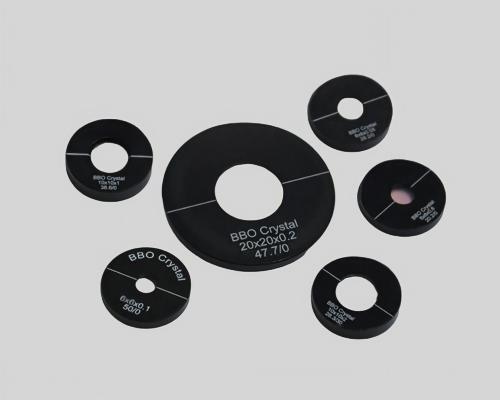
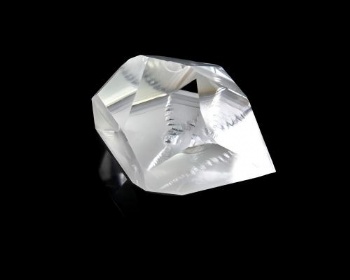
β-BaB2O4 (BBO, Barium Metaborate) is a widely used nonlinear crystal for frequency conversion in the UV, visible and NIR.
BBO
β-BaB2O4 (BBO, Barium Metaborate) is a widely used nonlinear crystal for frequency conversion in the UV, visible and NIR. It has the following characteristics:
large birefringence
Low dispersion
High damage threshold
Wide phase-matching range
Good temperature stability
Large nonlinear optical effects
A frequency multiplication factor six times higher than that of KDP crystals
BBO nonlinear crystal can be used in high, precise and advanced laser technology fields of research and development. These fields include all-solid-state tunable laser, ultrafast pulsed laser, deep ultraviolet Laser, etc. It is also used for the following purposes:
Nd:YAG and Nd:YLF lasers for frequency doubling
Tripling and mixing of dye lasers
Ti:Sapphire and Alexandrite lasers for frequency doubling
Tripling and quadrupling
Optical parametric amplifiers (OPA)
Optical parametric oscillators (OPO)
Argon ion, ruby, and Cu vapor lasers for frequency doubling
The features of BBO nonlinear crystal:
Good physical properties
Appropriate mechanical properties
Temperature bandwidth about 55 °C
High optical uniformity: δn≈10-6/cm
Transmission range from 190 nm to 3500 nm
Phase matching range from 6 nm to 3500 nm
Large effective SHG (second harmonic generation) coefficient
100 ps pulse damage threshold of 10 J/cm2 at 1064 nm
Specifications: | |||
Dimension Tolerance | (W±0.1mm)x(H±0.1mm) | Clear Aperture | central 90% of the diameter |
Scattering of Crystals | No visible scattering paths or centers | Flatness | less than λ/8 @ 633nm |
under the inspection of 50mW green Laser | |||
Transmitting Wavefront Distortion | less than λ/8 @ 633nm | Chamfer | ≤0.2mmx45° |
Chip | ≤0.1mm | Surface Quality | better than 10/5 S/D (MIL-PRF-13830B) |
Parallelism | ≤20 arc seconds | Perpendicularity | ≤5 arc minutes |
Angle Tolerance | ≤0.25° | Quality Warranty Period | one year under proper use |
Mount | Diameter 1" or Custom |
Chemical and Structural Properties: | |||
Crystal Structure | Trigonal, space group R3c | Lattics Parameters | a=b=12.532Å, c=12.717Å, Z=6 |
Melting Point | About 1095℃ | Mohs Hardness | 4 |
Density | 3.85g/cm3 | Thermal Conductivity | 1.2W/m/K(┴c): 1.6W/m/K(//c) |
Thermal Expansion Coefficients | a11=4x10⁻⁶/K; a33=36x10-6/K |
Optical and Nonlinear Optical Properties: | |||
Transparency Range | 190-3500nm | SHG Phase Matchable Range | 409.6-3500nm(Type I) 525-3500nm(Type II) |
Therm-optic Coefficients(/°C) | dno/dT=-16.6X10-6 dne/dT=-9.3X10-6 | Absorption Coefficients | <0.1%/cm at 1064nm <1%/cm at 532nm |
Angle Acceptance | 0.8mrad-cm (θ, Type I,1064 SHG) | Temperature Acceptance | 55℃-cm |
1.27mrad-cm (θ, Type II,1064 SHG) | |||
Spectral Acceptance | 1.1nm-cm | Walk-off Angle | 2.7° (Type I 1064 SHG) 3.2° (Type II 1064 SHG) |
NLO Coefficients | deff(I)=d31sinθ+(d11cosΦ-d22sin3Φ)cosθ | Non-vanished NLO Susceptibilities | d11=5.8xd36(KDP) d31=0.05xd11 d22<0.05xd11 |
deff(II)=(d11sin3Φ+d22cos3Φ)cos2θ | |||
Sellmeier Equations(λ in μm ) | no2=2.7359+0.01878 / (λ2-0.01822) -0.01354 | Electro-optic Coefficients | r22=2.7pm/V |
λ2 ne2=2.3753+0.01224 / (λ2-0.01667) -0.01516 λ2 | |||
Half-wave Voltage | 7KV (at 1064nm,3*3*20mm3) | Resistivity | >1011upohm-cm |
Relative Dielectric Constant | εs11/εo:6.7 εs33/εo:8.1 Tan δ<0.001 |
LiveChatX


 Send Email
 WhatsApp